 TruthfulPaws
 Neakasa M1 Plus Review: Best Open-Top Box, Sensor Problems

Quick Verdict
The only open-top automatic litter box that fits a 20-lb Maine Coon at a reasonable price. Half the cost of a Litter-Robot 4. About month 6-7, the IR sensors start degrading and the drum gets stuck inverted mid-cycle, locking cats out.

The pitch is straightforward. Open-top design that actually fits a 20-pound Maine Coon. Half the price of a Litter-Robot. Arrives mostly assembled. Thousands of five-star reviews from people who say it changed their lives.
All of that is true. And if you stop reading Amazon reviews at the three-month mark, it stays true.
But scroll down to the reviews posted six, eight, twelve months after purchase. The same owners who called it "a damn blessing" are back, rating it one star, describing a machine frozen mid-rotation with the drum inverted and their cats going on the carpet. The IR sensors that detect whether the waste bin is full get dirty, degrade, and begin reporting false positives. When that happens, the machine stops upside-down and cannot be remotely reset. That is not a fringe experience. The temporal data from Amazon's review corpus shows the average rating for units purchased in mid-2025 fell below 3.0.
The M1 Plus earns a 2.9/5 overall. That score reflects a product that genuinely solves a real problem for a specific group of cat owners, then makes you work to keep it working.
TruthfulPaws Score: 2.9/5
We scored the M1 Plus using our self-cleaning litter box methodology, synthesizing over 500 Amazon reviews, 48 Reddit posts across r/neakasa, r/catcare, and r/litterrobot, and 15 YouTube videos. Scores are weighted by source credibility, with long-term ownership accounts and unsponsored reviewers carrying more weight than first-week impressions.
-
Cleaning Performance
25%3.0Works reliably with fine clumping clay. Demands ongoing calibration: cycle timing, litter depth, type. ~8-9% cite incomplete sifting as a primary complaint. Not set-and-forget. -
Safety
20%2.0The M1 Plus hardware fix is real — a redesigned gear prevents over-rotation. But the original M1 caused at least one confirmed fatality, some sellers still ship the old model, and sensor degradation introduces ongoing uncertainty. -
Odor Control
20%3.5Mostly excellent with fine clumping clay and a bin emptied every 3-4 days. The waste drawer fully opens during the dump cycle, releasing a brief odor burst. Wrong litter or an overfull bin turns excellent into bad. -
Ease of Use
20%3.0Setup is genuinely easy; the first month is low-effort. Long-term tells a different story: sensor cleaning on hands and knees, 2.4GHz WiFi-only restrictions, silicone liner degradation, bag alignment errors. -
Value
15%3.0Less than half the price of a Litter-Robot 4. If it lasted comparably this would score higher. Sensor failures at 6-7 months, a one-year warranty, and a cheaper CatLink open-top competitor all pressure the value case.
The Open-Top Advantage Is Real
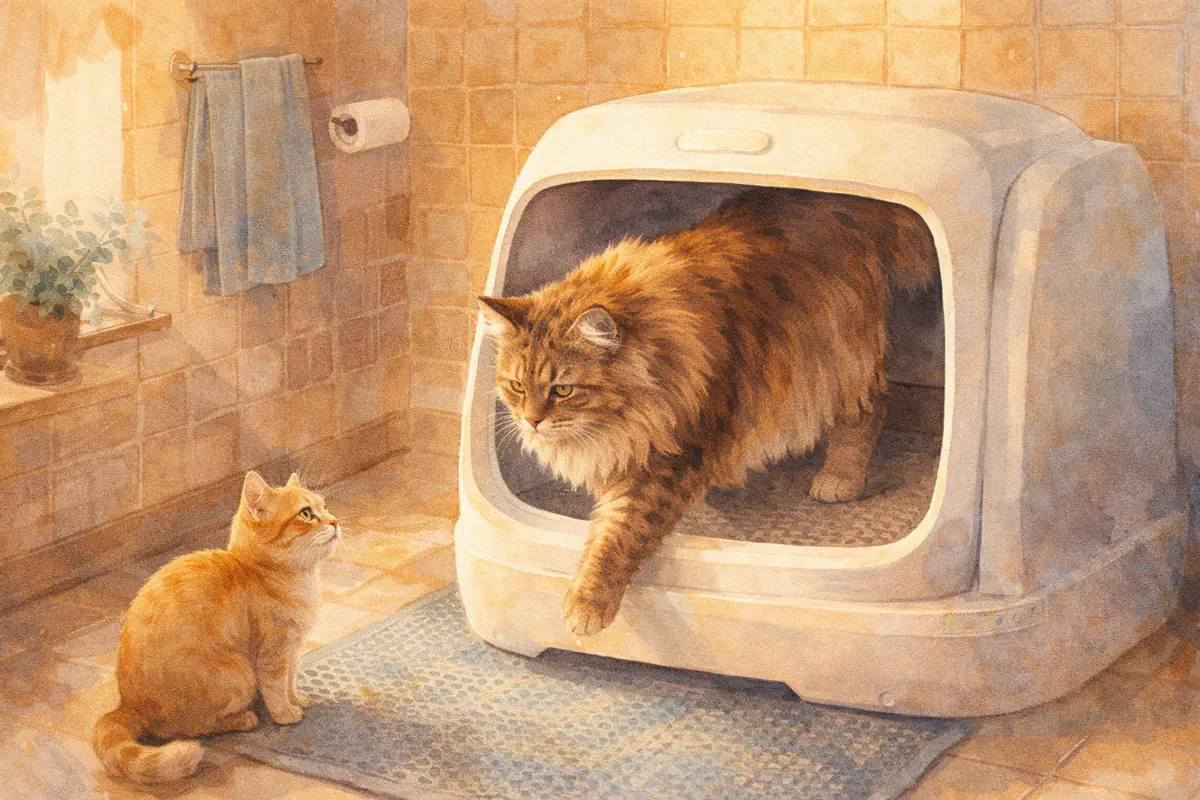
Roughly 15% of cat owners have a large or XL cat who physically cannot use an enclosed box. Maine Coons, Ragdolls, big male tabbies, Sphynxes who pee standing up. For them, the standard automatic litter box market simply doesn't work. The Litter-Robot's globe is too small. The PETKIT PuraMax is enclosed. Most alternatives at any price either don't fit or don't have the sensor sophistication to be trusted.
One Amazon reviewer with two cats (a 20-pounder and a 13-pound cat) went through a Litter Maid, then a PetSafe model, before landing on the M1 Plus. "There were many reasons [the PetSafe] wasn't a good choice," they wrote in their review. "[The M1 Plus] works beautifully."
On r/neakasa, owners of very large cats repeat this refrain. "We really love our Neakasa for our XXXL boy who doesn't fit in any other litter box we've found," one owner wrote in an 8-month honest review thread. The same thread notes that with five cats in the house, the M1 Plus handles volume that no enclosed box at this price would manage.
One Man Five Cats, the most credible voice covering self-cleaning litter boxes on YouTube (over 80,000 subscribers, no undisclosed sponsors), called the M1 Plus "the most mature" open-top product on the market in his January 2026 comparison of open-top boxes. That endorsement matters because it came after the safety incidents, not before.
The open-top design also makes the box more welcoming to cats than an enclosed globe. There's no tunnel to navigate, no claustrophobia, no learning curve for a cat that already uses a standard box. Most owners report their cats adapting within a few days.
The trade-off: every gram of litter those cats fling when they dig and jump out lands on your floor instead of inside the box. More on that shortly.
The App Is More Useful Than It Sounds
A health-monitoring app on a litter box sounds like a gimmick until you actually need it.
The M1 Plus tracks each cat's weight and usage duration, which lets owners notice health changes early. A Reddit owner with six cats described how the app caught a health problem before she would have otherwise noticed:
"Once, one of my cats had diarrhea, and I was able to notice it very quickly because I saw that she was using the litter box many times and staying in it longer than usual."
For multi-cat households, distinguishing which cat visited and for how long is genuinely useful veterinary surveillance, not marketing copy.
The app requires 2.4 GHz WiFi only (not 5 GHz). Worth knowing before you buy; the box works fine without WiFi, you just lose remote controls and tracking. If your router situation is complicated, check our pet device WiFi troubleshooting guide first.
More Than a Budget Alternative
There are Litter-Robot 4 owners who buy the M1 Plus and prefer it. In the comment section of a direct LR4 vs. M1 comparison video, one multi-cat owner put it plainly:
"I have an LR4 and a Neakasa. I have 3 cats. My larger cat did not like the LR4 and would poop on the floor... Since I bought the Neakasa none of my cats use the LR4... for the issues I have had with both the LR3 and LR4 it's just not acceptable at that price point."
In a thread on r/neakasa titled "I couldn't recommend this thing more," a Litter-Robot owner running both side-by-side notes their cats are showing a preference for the Neakasa, and calls it "so much easier to maintain and keep clean."
The reverse also happens. But the comparison shouldn't be framed as premium versus budget. For large cats, the M1 Plus competes on its own terms.
Flaws but Not Dealbreakers
Litter tracking is genuinely bad. Open-top is the feature; litter on the floor is the tax. The Amazon data on this is unambiguous: 76% negative sentiment among the reviews that mentioned litter tracking, the worst-rated aspect in the entire dataset. Owners report sweeping twice daily. One long-term owner with a dedicated pedestal and honeycomb mat still sweeps twice per day. The included litter mat helps somewhat. If your litter box area is carpeted, budget for a larger mat and daily sweeping as a permanent part of your routine.
Setup is easy, deep cleaning is not. Attach four legs, add litter, plug in. Most owners are done in fifteen minutes. The friction points: the litter fill line is hard to see, bag installation has a learning curve, and the 2.4 GHz WiFi requirement catches people off-guard. A Cameron Alder Jade tutorial on deep cleaning the M1 Plus attracted significant owner interest; the process is manageable, but it takes time.
The silicone liner won't last forever. Cats with aggressive digging habits can damage it within months. Replacement liners are frequently out of stock on the official Neakasa site and hard to find elsewhere. If you have a known digger, factor this in.
Customer service is a weak point. Support is email-only, based overseas, and slow. Several Reddit and Amazon owners describe weeks of back-and-forth that didn't resolve their issue. Neakasa responded well when the safety incidents became public pressure in 2025. Routine post-sale support is a different story. The one-year US warranty is short for a machine at this price.
The Sensor Problem You Need to Know About
This is where the five-star reviews and the one-star reviews diverge, and why the timing matters.
The waste bin IR sensors detect whether the bin is full. Over time, they get dirty, degrade, and start reporting false positives. When this happens, the machine stops mid-rotation, inverted with the drum facing down, and stays there. Cats are locked out. The machine cannot be remotely reset. You have to physically go flip it back, clean the sensors, and hope it holds.
One owner who purchased in October 2024 described the experience in a thread on r/neakasa:
"Like clockwork, I started getting issues with the waste-bin sensors in January this year. The only thing that fixes it is wiping down the sensors... no matter what, the error always comes back."
That's roughly three months of use before the problem appeared. The most consistent failure timeline: sensor issues between months three and seven, with cleaning buying time for some and becoming futile for others. Motor failures follow a similar arc.
One Amazon review describes it in three acts: "Amazing for about 3 months... After a little over 3 months, an error started about once a week... About 2 weeks later, an error 'Motor Overload' started appearing. Now the motor just doesn't work at all." Dozens of owners describe the same progression.
Amazon's headline rating of 4.0/5 accurately captures the experience of owners in the first three to six months. The temporal data tells a different story: the average rating for units purchased in mid-2025 was consistently below 3.0. Those aren't bad units. They're the same units, eight months later.
The Safety History, Addressed Directly
The original M1 had a design defect in the rotation gear. The position-sensing magnets could displace from the silicone liner, causing the drum to over-rotate. This resulted in two confirmed cat injuries and one confirmed death. One Man Five Cats pinned an urgent warning on his original M1 review: "URGENT HARDWARE UPDATE: If you have an M1 it's essential that you contact support to get them to send you a new motor gear... I do not recommend you have auto cleaning turned on unless you have this due to a number of incidents including one confirmed fatality."
The M1 Plus physically addresses the defect. The new motor gear has two teeth missing, which makes over-rotation mechanically impossible regardless of firmware state. Mark's Tech Vlogs documented the cog installation in detail; the fix is real, and One Man Five Cats confirmed in his January 2026 roundup that current M1 Plus units have the hardware update pre-installed.
The concern isn't that current M1 Plus units have the original defect. They don't.
The concern is narrower: multiple r/neakasa users ordered the M1 Plus from Amazon and received the original M1. One owner documented a bait-and-switch experience buying directly from Neakasa's Amazon storefront. Before first use, verify your unit says M1 Plus and confirm the redesigned gear is present. The r/neakasa community PSA thread, posted by u/ufgrat, has a detailed breakdown of what to look for.
There is also a separate ongoing safety consideration: when the bin sensor trips a false "full" alert, the machine stays inverted and cats are locked out. For a senior cat with urgency, or in a household where no one will notice for twelve hours, this creates real risk. It's a different issue from the over-rotation defect, but it matters.
Mark's Tech Vlogs, who purchased his unit himself and wrote a one-year ownership review, ultimately does not recommend the M1. His sensor failed within warranty; replacement sensors arrived with extra glue, which he treats as evidence of a known manufacturing issue. The daily experience is good about 97% of the time, he says, but the safety history and sensor reliability make the overall case difficult.
Cats.com, which purchased independently and consulted a veterinarian, noted one genuine safety advantage of the open-top design: a cat caught inside during a malfunction can simply jump out. Enclosed globes can't say the same.
How It Compares
The Litter-Robot 4 is the benchmark for this category: better long-term durability, 25-year parts ecosystem, real customer support. If your cats fit in the globe and you can stretch the budget, buy it instead.
The PETKIT PuraMax 2 is a solid enclosed option at a mid-range price with stronger durability data than the Neakasa. Worth considering if open-top isn't required.
The Casa Leo Leo's Loo Too earns the best safety scores in the enclosed category. Budget-stretching pick for owners who prioritize reliability above all else.
The CatLink Open-X is the most direct pressure on the M1 Plus: an open-top box at roughly half the price. One Man Five Cats, in his January 2026 open-top comparison, put it directly: "The CatLink being essentially half the price, it becomes a really difficult argument to make for the Neakasa." The CatLink is newer with limited long-term data. Buyer's risk. The M1 Plus has the longer track record.
The MeoWant 106L (our full review) and Fumoi are rotating drum options in the same price tier; neither addresses the open-top large-cat gap. See the full ranking with safety scores, year 1 costs, and vet-reviewed data in our self-cleaning litter box comparison guide.
Before You Set It Up
Confirm you have the M1 Plus, not the M1. The M1 Plus gear has two missing teeth; the original M1 gear is continuous. If you received the wrong model, contact Neakasa support before using auto-clean mode.
Update firmware immediately after WiFi setup. And use fine clumping clay: Arm & Hammer Clump & Slide, Dr. Elsey's Ultra, or Fresh Step. The reviews that rave about "zero smell" almost universally mention one of these. The reviews that complain about persistent odor are frequently on the wrong litter type or running the bin too full. That one variable explains most of the gap between the best and worst owner experiences.
Final Verdict
The Neakasa M1 Plus is the best automatic litter box on the market for large cats who can't use enclosed boxes. That is a real need, and for the owners who have it, this product fills a gap that nothing else at a reasonable price fills as well. The first three to six months are genuinely good. Easy setup, reliable cleaning, useful app, quiet enough for a bedroom.
Then the sensors start.
The durability trajectory is documented well enough to call it expected rather than unlucky. Plan for sensor cleaning as a regular maintenance task. Keep the bin emptied every three to four days. Use the right litter. And buy from Amazon directly so you have a return window if something goes wrong early.
At its price relative to the Litter-Robot, with the specific use case of large cats, the M1 Plus earns its recommendation. Just know what you're signing up for.
- Your cat is 12+ lbs and won't fit in an enclosed rotating box
- You have 2 cats and want reliable automation at half of LR4 prices
- You travel often and need 2-4 days of reliable coverage
- Your litter box sits on carpet (tracking is structural)
- You use crystal, pellet, or standard tofu litter (only fine clumping clay works)
- You have a senior or anxious cat who needs predictable access