PetLab ProBright Review: 6,100+ Owner Experiences
Quick Overview
Pros
- Breath improves within 2-4 weeks for most dogs — 74% of 6,100+ verified buyers report improvement
- No toothbrush required — sprinkle on food daily; ideal for dogs that refuse brushing
- 86% of dogs accept the chicken liver flavor without noticing it in food
- Fills a genuine gap for senior dogs where anesthesia risk makes professional cleaning inadvisable
- NASC-certified manufacturing; no xylitol or artificial preservatives
Cons
- No VOHC seal of approval — ProDen PlaqueOff (same primary ingredient, 35-50% lower cost) has earned it
- About 1 in 5 dogs experiences digestive upset on abrupt introduction — gradual dosing required
- Full dental results (tartar, whitening) take 2-5 months; 18% of dogs see no meaningful results
PetLab ProBright
As an Amazon Associate I earn from qualifying purchases. This article analyzes 6,100+ data points across Amazon, YouTube, and Reddit to provide evidence-based recommendations. Our research methodology and product selection are independent and unbiased.
Quick Overview
KRA has two aging dogs. One of them developed a condition that puts anesthesia at serious risk, which means the annual professional dental cleaning is no longer safely on the table. So KRA bought PetLab Co. ProBright Dental Powder, gave it 90 days, and posted the result on Amazon. That review became the most-upvoted on the entire listing. The verdict: "WORKS. Full stop. CONs: Price."
That kind of review tells you something real. And it turns out the data behind it holds up. Among more than 6,100 Amazon verified buyers, 74% report meaningful breath improvement within 2-4 weeks of daily use. The same finding shows up across Reddit voices and the two genuinely independent YouTube reviewers we identified in a field of 13 videos (10 of which are paid promotions).
Here is the honest version before we go further. Results follow a two-phase pattern: breath improves first, in 2-4 weeks for most dogs, while tartar reduction and visible whitening take much longer, often 2-5 months. About 18% of dogs see no meaningful benefit. About 1 in 5 dogs develops digestive upset when the product is introduced at full dose immediately. The product does not hold a VOHC (Veterinary Oral Health Council) seal, and its primary active ingredient is available in a competing product at 35-50% lower cost.
The product earns a 3.7 out of 5. It genuinely helps the dogs it was designed for, but it is not right for every dog or every household.
What Is ProBright Dental Powder
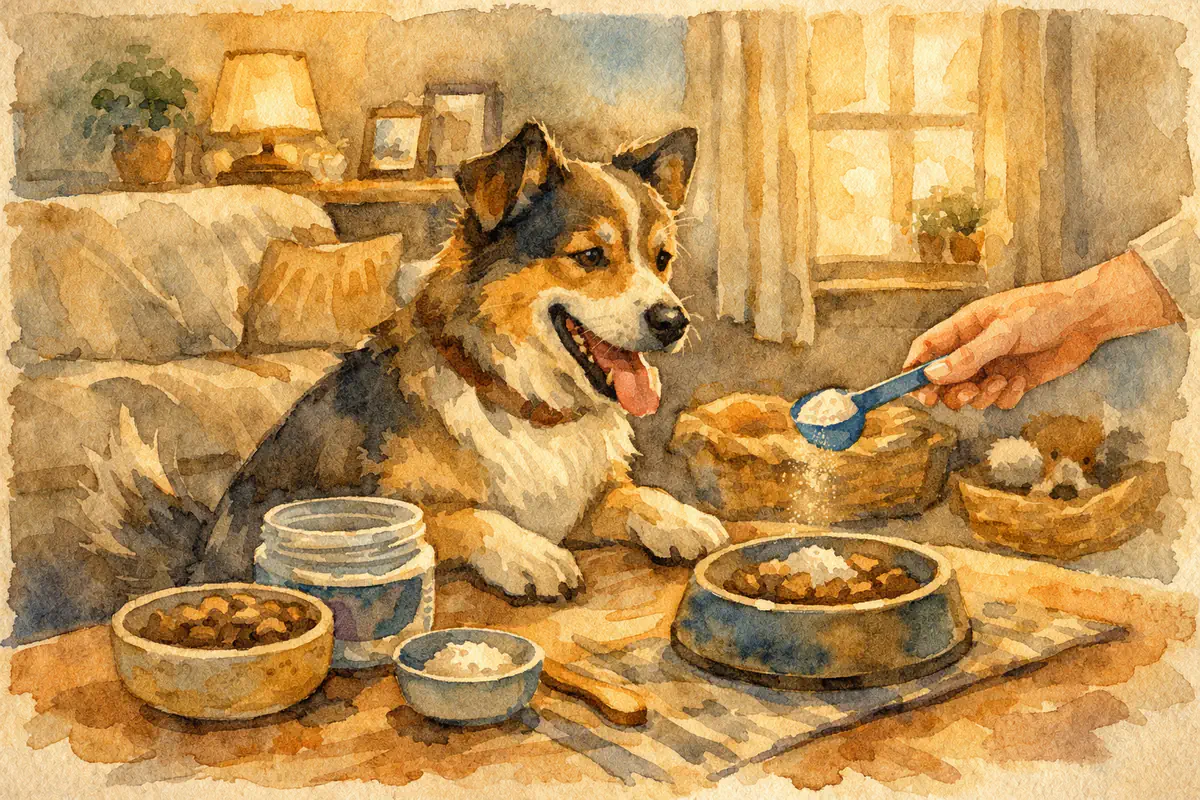
ProBright is a food-additive dental supplement. One daily scoop goes directly onto your dog's meal. No toothbrush required. No behavioral cooperation from the dog. The powder has a chicken liver flavor, dissolves easily into wet food, and blends into dry kibble with a small amount of added water.
The primary active ingredient is ascophyllum nodosum, a type of brown algae (sometimes called Norwegian kelp). After your dog eats it, the compound is absorbed through the gut and secreted into saliva. Once in saliva, it chemically interferes with the bacteria that colonize tooth surfaces and produce the volatile sulfur compounds responsible for bad breath. This is the same core mechanism used by ProDen PlaqueOff, the market leader in the seaweed-based dental supplement category. We will cover that comparison in detail.
Additional ingredients include a probiotic blend, green tea extract, and rosemary extract. The formula is NASC-certified (National Animal Supplement Council), a meaningful quality signal for manufacturing standards including heavy metal testing and label accuracy verification. It is made in the USA, contains no xylitol, and uses no artificial preservatives.
ProBright comes in three size variants: XS (up to 25 lbs), Small-Medium (26-55 lbs), and Large-XL (56 lbs and up). Each size uses different dosing, and different formulations are not interchangeable across sizes. The XS size has a documented per-ounce value problem: reviewers consistently flag that it contains significantly less product for nearly the same price as larger sizes. If your dog lands at the upper end of the XS weight range, it is worth checking whether the Small-Medium formula might be appropriate.
| Method | Effort Required | Timeline | Requires Dog Cooperation? |
|---|---|---|---|
| ProBright (food additive) | One daily scoop | 2-4 weeks (breath) | No |
| Enzymatic toothpaste + brushing | Daily brushing | 1-2 weeks | Yes |
| Water additives | Add to bowl | Weeks (variable) | No |
| Dental chews | Daily treat | 4-8 weeks | Minimal |
What the Data Actually Shows
We analyzed more than 6,100 Amazon verified purchase reviews, 13 YouTube videos (of which 10 were paid promotions), and Reddit discussion in the brand-managed r/PetLabCo community. When a YouTube commenter observed that "every SINGLE video about this stuff all has 'honest review' in the title. So obviously a paid endorsement," they were essentially correct. Given that, we weighted Amazon's large verified-purchase sample as the primary data source and used YouTube comment threads and Reddit voices to triangulate specific claims.
Here is what the data actually shows.
Breath improvement is real and consistent. 74% of more than 6,100 verified Amazon buyers report meaningful breath improvement within 2-4 weeks. This is the single most consistent finding across all three platforms we analyzed. Reddit's four independent voices all confirmed breath improvement at around the one-month mark. Both genuinely independent YouTube reviewers corroborated it. One Amazon buyer named Sherrie G described it plainly: "His teeth started looking so much better and his breath smelled 100% better."
Results follow a two-phase pattern. Breath comes first, typically within 2-4 weeks. Tartar softening and visible whitening follow much later, most often at the 2-5 month mark. These are separate outcomes on different timelines. Among Amazon buyers who specifically mentioned tartar or whitening, 61% reported visible improvement. Reddit user DigPsychological2876 captured the arc: "The yellowing on her canines has definitely improved. I noticed that after about 5 months. The first changes happened around the 30-day mark."
86% of dogs accept the powder without noticing it. The chicken liver flavor works well across a wide range of breeds and sizes. YouTube creator Canine Antics, who tested the product with 10 dogs, confirmed that all of them ate without hesitation. Palatability rejection, which affects roughly 14% of dogs, tends to occur on dry kibble alone. Wet food or a small amount of water helps significantly.
About 18-20% of dogs experience no noticeable results. This is not a small number. There is no reliable way to predict which dogs will respond. The most consistent pattern among disappointed buyers is evaluating at 30 days and expecting tartar results on a timeline that does not match how the product works, which makes the problem primarily one of mismatched expectations, not necessarily product failure.
About 1 in 5 dogs develops digestive upset on abrupt introduction. Across more than 6,100 Amazon reviews and corroborated by Chewy data, 38+ documented instances describe diarrhea, loose stools, or vomiting in dogs given a full dose immediately. This is the most important practical risk and the one the brand's marketing underemphasizes. The gradual introduction protocol in its own section below addresses this directly.
Cost is the top complaint. 87+ Amazon mentions and consistent Reddit commentary name price as the primary friction point. bronniebballs on r/PetLabCo, managing six dogs, described it concisely: "It kills me to need so many little jars for a month." For single-dog households where the product works, most owners continue buying. For multi-dog households, the monthly math compounds quickly.
The plateau finding. Diana Kitsune, the most detailed independent YouTube reviewer we identified, published a walkthrough of the product with a 2025 update noting that results "eventually just kind of plateaued" when the powder was used as the sole dental intervention. This is consistent with what veterinary dentists observe: passive supplements have an effectiveness ceiling over time without periodic mechanical plaque disruption.
Flaws but Not Dealbreakers
The most significant flaw is the absent VOHC seal. The Veterinary Oral Health Council requires independent laboratory demonstration of at least 10% reduction in plaque or tartar versus a control before granting certification. ProBright has not earned this. Its primary active ingredient (ascophyllum nodosum) is available in ProDen PlaqueOff, which does hold the VOHC seal at 35-50% lower cost. PetLab's brand marketing leans on a 28-day internal study measuring breath-odor compounds specifically, which is a narrower claim than the plaque and tartar endpoints the VOHC seal requires. Informed buyers should weigh this gap carefully before paying a price premium over PlaqueOff.
The digestive side effect rate is real and under-disclosed. About 1 in 5 dogs develops diarrhea, loose stools, or vomiting when started at full dose. This is higher than the tolerability expectation for a daily maintenance supplement and higher than the tolerability profile of ProDen PlaqueOff, which has a much shorter ingredient list. The brand's label does not prominently feature this risk. Gradual introduction over two weeks substantially reduces the problem, but it requires proactive management the packaging does not encourage.
The effectiveness plateau is the least well-documented flaw, but it is plausible and worth knowing. Diana Kitsune noted the product's effectiveness stalled after extended solo use. A YouTube commenter named genesissage3303 offered a reasonable explanation: "I think the plateau people undergo is the result of thinking the powder is going to replace brushing, which it isn't." The mechanism behind ascophyllum nodosum works best as one layer of dental care, not the whole thing. Plan for that from the start rather than discovering it at month 12.
Who Should Buy ProBright
If your dog refuses to let anyone near their mouth with a toothbrush, ProBright was designed for exactly this situation. The food-delivery mechanism bypasses the need for brushing entirely. Among the 6,100+ Amazon reviews, 74 specifically mentioned that no brushing is required as a primary benefit. Reddit user __xoxobunnyboo captured the use case: "My dachshund refuses to let me near his mouth with a toothbrush but he eats the powder no problem when I put it in his food." A supplement that gets used every day beats the gold standard that never gets applied.
If you have a senior dog with bad breath or mild tartar, especially where anesthesia poses a health risk, this is the product's most compelling use case. KRA's Amazon review, with 617 helpful votes, describes this situation precisely: dogs getting older, one now at risk of not surviving anesthesia, a long history of failed alternatives, then ProBright. The verdict is two words. Reddit user Apart-Supermarket719 described their 13-year-old Maltese: "It has been the holy grail for my senior pup. You can really tell the difference in breath by A LOT and her teeth are looking pearly." For owners navigating dental care in senior dogs without safe access to professional cleaning, this product fills a real gap.
If your dog recently had a professional dental cleaning and you want to extend the interval, ProBright works well in the maintenance role. The mechanism inhibits new plaque formation and softens active biofilm before it mineralizes into hard calculus. Owners who use it as a post-cleaning maintenance tool report the strongest long-term outcomes.
If you tried ProDen PlaqueOff but your dog rejected the seaweed flavor, ProBright's chicken liver formula solves that specific access problem. PlaqueOff is the better-valued product in most other respects, but its natural ocean smell causes some dogs to refuse it. Palatability matters enormously for daily compliance.
PetLab ProBright
🎯 Which ProBright Size Is Right for Your Dog?
How much does your dog weigh?
Who Should Skip ProBright
If your dog has a sensitive stomach, IBD, or a history of chronic diarrhea, the 20% digestive adverse event rate is a real risk even with gradual introduction. The likely trigger is sodium hexametaphosphate, a sequestrant in the formula that can disrupt calcium absorption in sensitive dogs. For dogs with pre-existing GI conditions, ProDen PlaqueOff has a narrower ingredient profile and a lower GI risk.
If you have three or more dogs, the per-dog monthly cost compounds into a significant ongoing expense. ProDen PlaqueOff uses the same primary active ingredient, holds the VOHC seal ProBright does not, and costs substantially less per dog per month. It is also available in larger containers that improve per-ounce value further.
If you are not ready to commit to 60-90 days, this is not the right purchase. The 18% no-results group is heavily weighted toward buyers who evaluated at 30 days expecting tartar results on a timeline that requires months, not weeks. Amazon buyer Yoda G. offered this to future buyers: "Do not think that the product is going to instantly kill that funky breath your furbaby has. This formula is gentle."
If your dog clinically needs professional dental treatment right now, no supplement is a substitute. Hard calcified tartar, tooth root abscesses, periodontal disease, and resorptive lesions require veterinary diagnosis and treatment. Supplements can maintain results after a cleaning, but they cannot treat established dental disease.
If your dog has confirmed thyroid disease or iodine sensitivity, the ascophyllum nodosum in this formula contains significant iodine. Discuss with your veterinarian before use. The same applies to dogs with a confirmed poultry protein allergy, since the chicken liver flavoring may trigger an allergic response.
If you tend to set up subscriptions and forget about them, buy one-time first. The brand's subscription model has generated documented complaints about unauthorized charges and difficulty canceling. These are customer service issues, not product formulation issues, but they are real.
| If this describes you | Better option |
|---|---|
| Dog has sensitive stomach or IBD | ProDen PlaqueOff (simpler ingredient profile) |
| Household with 3+ dogs | ProDen PlaqueOff (lower cost, VOHC-approved) |
| Dog needs treatment now | Veterinary dental appointment first |
| Dog has thyroid disease | Consult your vet before any kelp supplement |
What to Expect and When
The two-phase timeline is the most important thing to understand before buying. Mismatched expectations drive nearly every disappointed review.
Phase 1: Breath improvement (Weeks 2-4). Most dogs show noticeable breath improvement within 2-4 weeks of daily use. 74% of more than 6,100 Amazon verified buyers report this outcome. The Reddit community thread shows all four independent users confirming breath improvement at around the one-month mark. One sponsored video claimed results within one week. That claim comes from a paid 42-second short and should be discounted. The Amazon and Reddit data consistently point to 2-4 weeks.
Phase 2: Tartar softening and whitening (Months 2-5). This is a separate, longer-horizon outcome. About 61% of Amazon buyers who specifically mention tartar or whitening report visible improvement. Reddit user DigPsychological2876 described the full arc: first changes at 30 days on breath, yellowing on the canines visibly improved at five months. That is a realistic timeline for meaningful tartar reduction, not a failure mode.
What it will not do. ProBright softens active plaque biofilm and inhibits new plaque formation. It does not remove hard calcified tartar that has been building for years. Visible brown or yellow mineral deposits that feel hard to the touch require professional scaling. The supplement prevents new buildup after a cleaning, but it will not dissolve existing calculus.
A note on PetLab's clinical claim. In a brand-conducted internal study, ProBright showed reduction in volatile sulfur compounds (the chemical sources of bad breath). This is directionally consistent with the published science on ascophyllum nodosum, but the study is not peer-reviewed. "Clinically studied" should not be read as independently verified data.
How to Introduce It Without Upsetting Your Dog's Stomach
About 1 in 5 dogs develops digestive upset when ProBright is introduced at full dose from day one. The most common symptoms are diarrhea and loose stools, occasionally vomiting. Amazon reviewer V documented the experience: her dog "started liquid pooping and had me up every single hour of the night." Not dangerous for most dogs. Very disruptive.
The fix is a gradual introduction over two weeks.
Days 1-7: Give one-quarter of the recommended dose for your dog's size. Mix into wet food or add water to dry kibble to help it blend evenly.
Days 8-14: Increase to half the recommended dose. Watch for any change in stool consistency. If digestive issues appear, drop back to one-quarter dose for another week before trying to increase again.
Day 15 and beyond: Move to the full recommended dose. Dogs that tolerate the gradual approach typically continue without any further GI issues.
Important note for higher-risk dogs: If your dog already has IBD, colitis, or a history of GI problems, start at one-eighth dose for the first week and consider whether this product is the right choice given the 20% base adverse event rate. Dogs with calcium metabolism disorders should avoid it entirely. The calcium-chelating properties of sodium hexametaphosphate, a sequestrant in the formula, can interact with these conditions.
The brand's label does not prominently feature gradual introduction guidance. This is why an honest review covers it.
The Ingredient Science in Plain Language
Understanding what is actually in this product helps clarify what it can and cannot do.
Ascophyllum nodosum (brown algae/kelp) is the primary active ingredient and the only one with meaningful peer-reviewed support. After digestion, it is secreted into saliva, where it inhibits the bacteria that form plaque and generate volatile sulfur compounds. Two veterinary dentistry journal studies demonstrate 20-36% reductions in plaque index scores in supplemented dogs versus controls over 4-12 weeks. It works best as a prevention and maintenance tool. One transparency gap: PetLab does not disclose the polysaccharide standardization of their extract, which branded competitors like PlaqueOff specify. A minor concern, but a gap.
Probiotics are theorized to work through competitive exclusion, with beneficial bacteria crowding out plaque-forming anaerobes in the oral cavity. The published evidence for this mechanism specifically in dog dental health is limited. There are no peer-reviewed canine oral microbiome studies using this delivery format. Probiotics may support gut health generally, but they should not be presented as a primary dental mechanism here.
Green tea extract shows antimicrobial properties in laboratory studies against oral pathogens. The evidence is based largely on human in vitro research at concentrations likely higher than what is present in this supplement. No published canine dosing studies establish effective doses for dental applications in this format. A supporting ingredient with theoretical merit.
Rosemary extract is the weakest dental ingredient in the formula. Its most documented function in this context is as a natural preservative, keeping the powder shelf-stable without artificial antioxidants. Dental-specific benefits are largely theoretical.
| Ingredient | What It Does | Evidence Level |
|---|---|---|
| Ascophyllum nodosum | Inhibits plaque bacteria via saliva | Moderate (peer-reviewed) |
| Probiotics | Competitive exclusion of oral pathogens | Limited (plausible, not proven in dogs) |
| Green tea extract | Antimicrobial; antioxidant | Limited (lab studies only) |
| Rosemary extract | Natural preservative; antioxidant | Weak (limited dental evidence) |
The safety profile across all four ingredients is genuinely strong. No xylitol, no artificial preservatives, no synthetic sweeteners.
Is It Worth the Cost
Cost is the most common complaint across all three platforms. Whether the price is justified depends almost entirely on what you are comparing it to.
The financial case is strongest for two situations. First, for dogs with documented anesthesia risk, the monthly supplement cost compares favorably to a procedure that may not be safely available. Second, for dogs where daily use extends professional cleaning intervals from annual to 18-24 months, the supplement cost is partially offset by procedure savings. One Chewy reviewer described exactly this outcome: their vet noted the dog's teeth were excellent, whereas previously that dog had always needed a cleaning.
The math breaks down for multi-dog households with three or more dogs. Per-dog costs compound quickly, especially compared to a lower-cost alternative using the same primary mechanism. For young, healthy dogs that could instead establish a brushing routine, the ongoing monthly cost is harder to justify.
The honest competitor comparison: ProDen PlaqueOff uses the same primary active ingredient, holds the VOHC seal ProBright lacks, and costs significantly less per month. The main reason to choose ProBright over PlaqueOff is palatability. PlaqueOff has a pronounced seaweed odor that some dogs reject. If your dog accepts PlaqueOff, that product represents better cost efficiency and stronger third-party validation. If your dog refuses it, ProBright's chicken liver flavor is a practical answer to a real problem.
The math only makes sense in these situations:
- Senior dogs with documented anesthesia risk (no safe alternative)
- Dogs that successfully extend cleaning intervals from annual to 18-24+ months
- Dogs that specifically rejected ProDen PlaqueOff due to flavor
- Single-dog households where the monthly cost is manageable
How It Compares to Other Dental Options
No head-to-head efficacy data exists comparing ProBright directly to these alternatives. What follows is a category-level comparison based on documented mechanisms and third-party validation status.
| Product/Method | VOHC Seal | Monthly Cost | Effort | Best Use Case |
|---|---|---|---|---|
| PetLab ProBright | No | Mid-range | Minimal (scoop on food) | Toothbrush-resistant dogs; senior dogs with anesthesia risk |
| ProDen PlaqueOff | Yes | Lower (35-50% less) | Minimal (scoop on food) | Dogs that accept seaweed flavor; multi-dog households |
| Virbac CET Enzymatic Toothpaste + brushing | Yes | Low | High (daily brushing) | Dogs that tolerate brushing; most effective home care |
| Greenies Dental Chews | Yes | Low-mid | Minimal (daily treat) | Complement to other care; dogs that enjoy chewing |
| Professional cleaning | N/A (procedure) | High (episodic) | None for owner | Heavy tartar; periodontal disease; complete oral reset |
ProDen PlaqueOff is the most directly comparable product. It uses the same primary mechanism, holds the VOHC seal ProBright lacks, and costs substantially less per month. Its main disadvantage is a pronounced seaweed odor that some dogs find unappealing. For dogs that accept PlaqueOff, it is the better-value choice. For dogs that reject the flavor, ProBright solves the access problem.
Enzymatic toothpaste and brushing is the gold-standard home dental care per the American Veterinary Dental College. It combines enzymatic action with physical plaque removal, making it the most effective at-home option available. The catch is daily brushing compliance. For toothbrush-resistant dogs, it is theoretically superior and practically inaccessible. That gap is exactly what ProBright fills.
VOHC-approved dental chews (Greenies, Virbac CET chews) provide mechanical plaque removal through chewing and address different oral surface areas than a food additive. They work as a complement to ProBright rather than a replacement. Owners with weight-appropriate dogs can reasonably layer both.
Professional cleaning under anesthesia is the only method that removes calcified tartar, treats established periodontal disease, and allows a complete oral health assessment. No supplement replaces this. ProBright is the daily maintenance layer between cleanings, not a substitute for them.
What Real Owners Say
The clearest picture of any product comes from the people who use it daily.
Amazon buyer Sherrie G summed up the core outcome: "His teeth started looking so much better and his breath smelled 100% better."
The toothbrush-resistance use case comes through most vividly in a Reddit thread where owners compared timing of breath vs. tartar results, where user __xoxobunnyboo wrote: "My dachshund refuses to let me near his mouth with a toothbrush but he eats the powder no problem when I put it in his food." The thread produced consistent reports: breath at about one month, tartar later.
For senior dogs, Reddit user Apart-Supermarket719 called it "the holy grail for my senior pup." A 13-year-old Maltese with severe chronic bad breath who showed clear improvement by the two-month mark. KRA's top-voted Amazon review documents the same situation at greater length, ending with: "WORKS. Full stop. CONs: Price."
The critical voices deserve equal space. Reddit user bronniebballs, managing six dogs, described the cost bluntly: "It kills me to need so many little jars for a month." A YouTube commenter documented two months of use with no visible results before booking a professional cleaning. And Diana Kitsune's detailed independent review with a 2025 update includes a note that the product "eventually just kind of plateaued" when used without brushing. Her review is the most longitudinal, balanced account of the product available on YouTube.
Amazon buyer Lillie, who described herself as skeptical after multiple failed alternatives, reported a meaningful difference after about two weeks on her Chihuahua mix and Yorkie. "I was very skeptical about buying this because I've tried several other products that didn't work at all." That skepticism, and the eventual result, is a representative arc for the product's strongest use cases.
Frequently Asked Questions
How long until my dog's breath improves?
Most dogs show noticeable breath improvement within 2-4 weeks of daily use. 74% of more than 6,100 Amazon verified buyers report this outcome. Commit to the full first month before evaluating. If you see no change at 30 days, give it another 2-4 weeks before concluding it will not work for your dog.
Does ProBright actually remove tartar?
It softens active plaque biofilm and inhibits new plaque formation, which reduces the rate at which soft plaque hardens into calculus. It does not remove hard, calcified tartar that has already accumulated. For visible tartar reduction, most owners who see it report improvement at the 2-5 month mark. Hard mineral deposits that have built up over years require professional scaling to remove.
My dog got diarrhea after I started using it. What should I do?
Stop or reduce to one-quarter dose immediately. This is the most common side effect, affecting roughly 1 in 5 dogs started at full dose. The most likely trigger is sodium hexametaphosphate, which can disrupt calcium absorption in sensitive dogs. Once symptoms resolve, try the gradual introduction protocol: one-quarter dose for 7 days, half dose for 7 days, then full dose. Most dogs that tolerate the gradual approach continue without further issues.
Is ProBright better than ProDen PlaqueOff?
For most dogs, ProDen PlaqueOff is the better-value choice. It uses the same primary active ingredient, holds the VOHC seal ProBright does not, and costs 35-50% less per month. The one scenario where ProBright wins is palatability: PlaqueOff has a strong natural seaweed odor that some dogs reject. If your dog accepts PlaqueOff, buy that. If they refuse it, ProBright's chicken liver formula solves a real practical problem.
Is it safe for senior dogs?
Yes, and senior dogs with anesthesia risk are one of the strongest use cases for this product. One caveat: ascophyllum nodosum contains iodine, and dogs with known thyroid disease should have veterinary input before starting any kelp-based supplement with long-term daily use. At the typical supplement dose, iodine content is not a concern for healthy dogs.
What if my dog refuses to eat food with the powder?
About 14% of dogs reject food with the powder mixed into dry kibble alone. Adding a small amount of water or mixing the powder into wet food usually resolves the issue. Several YouTube reviewers, including Canine Antics, specifically recommend hydrating kibble before adding the powder. If your dog still refuses, a VOHC-approved dental chew may be a better fit.
Does it replace professional dental cleanings?
No. ProBright is a maintenance tool, not a treatment. Professional cleanings are the only way to remove calcified tartar, treat periodontal disease, and get a complete oral health assessment including dental radiography. Dogs without anesthesia risk should still have annual veterinary oral exams. ProBright works best as the daily maintenance layer between those appointments.
How do I cancel the subscription?
Cancel through your PetLab account portal and document your signup date. Verified customer service complaints document difficulty canceling and charges continuing after cancellation. This is a brand trust issue, not a product formulation issue, but it is real. Buying one-time for the first order eliminates this risk.
Final Verdict
PetLab Co. ProBright Dental Powder earns a 3.7 out of 5. It is a genuinely useful product for a specific and underserved population: dogs that will not tolerate toothbrushing and senior dogs where anesthesia risk makes professional cleaning inadvisable. For these dogs, the product delivers real breath improvement in 74% of cases within 2-4 weeks, requires zero behavioral cooperation from the dog, and provides the easiest daily dental care routine available. KRA's top-voted Amazon review is not an outlier. It is a representative outcome for the right use case.
The honest limitations are real, too. The product lacks a VOHC seal of approval. Its primary active ingredient is available in a competing product at substantially lower cost with better third-party validation. Its internal clinical study cannot be treated as independently verified evidence. Roughly 1 in 5 dogs will see no meaningful benefit. The 20% digestive adverse event rate on abrupt introduction is under-communicated and worth managing proactively.
Worth it if: your dog refuses toothbrushing and currently gets no daily dental care; you have a senior dog with documented anesthesia risk; your dog had a professional cleaning and needs daily maintenance; your dog specifically rejected ProDen PlaqueOff due to flavor.
Skip it if: your dog has a sensitive stomach or chronic GI issues; you have three or more dogs where the per-dog cost becomes prohibitive; your dog clinically needs professional dental treatment now; you are not ready to commit to 60-90 days of consistent daily use.
Introduce it gradually, give it 90 days, and treat it as one layer of a dental care routine rather than the only layer. That is how this product performs at its best.
PetLab ProBright
This review analyzed 6,100+ data points across Amazon, YouTube, and Reddit using our credibility-weighted scoring methodology.